how i wonder
type: gratitude

what you are from inside a poem: not a complete sentence but a complete being.
When someone at one of my typewriter poetry sessions asks me to write a poem in appreciation of someone else, they’ll often list some flattering adjectives as part of the request. But those words aren’t all that helpful. Why? Because words that label a person—even positive words—are a hindrance. Because, for poetry to work, we have to get away from surface appearance and identity.
What I really need is a description of actions. Interestingly, our observation of someone’s actions is not the thing we naturally convey at first. It takes some thought.

I love this part of being a typewriter poet: encouraging a moment’s reflection, especially on the actions and gestures that are meaningful to us. It’s that reflection that gives me a much more direct path to the poem, and will hopefully give the recipients the most joy.
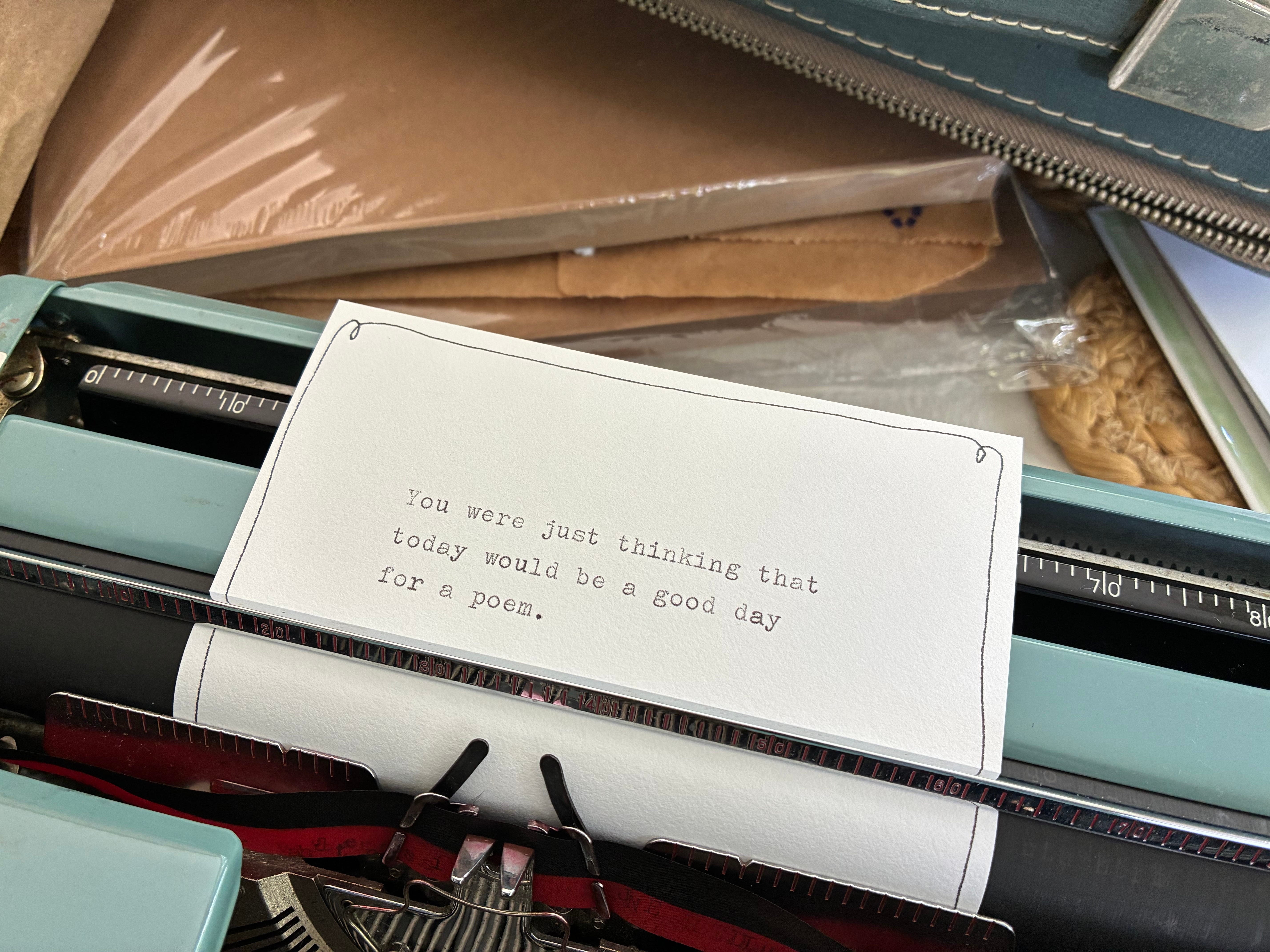
How does a poem turn an ordinary moment into an extraordinary flash of wonder and gratitude? In one method, I write the poem by putting myself in the persona of the person requesting it, and I imagine the scene—the actions and gestures they describe. Like this, a poem I wrote for someone at the library:
Portal
Many days I have loved watching you,
     startled at the doorway of our lives.
Cooking together, drinking wine,
     listening to the kids play and laugh,
I cannot take my eyes away,
     my heart’s transfixed.
While the mind gives us merely adjectives, the heart gives us movement. There are verbs, tastes, and sounds in a poem that the mind can’t offer, but our pulsing bodies do. Consider the braidedness of experience—thought, word, and action—and how a poem sends us a lifeline of beauty that sweetens the inner effort we need to expend in approaching wonder.
Type this:
Suppose something about another person has your attention today. Would it work as part of a poem or a song? It could be a positive thing, something you’re grateful for, or it could be something annoying or strange. Either way, consider the action of whatever it was that drew your attention, and then work your way back into thoughts. And then, of course, words, since that’s what poems are made of.